|
|
|
|
|
|
|
|
|
| THIS ITEM IS INCLUDED IN OUR BUY ONE GET ONE HALF PRICE OFFER ! Choose any two prints in this special offer and the lower priced item is half price. (Any free bonus prints already supplied with an item are separate and will also be included !) Hundreds of items across our websites are included in this offer! |
| |||||||||||||||||||||||||||||
| ||||||||||||||||||||||||||||||||||||||||||||||||||||||||||||||||||||||||||||||||||||||||||||||||||||||||||||
| Signatures on this item | |
| *The value given for each signature has been calculated by us based on the historical significance and rarity of the signature. Values of many pilot signatures have risen in recent years and will likely continue to rise as they become more and more rare. | |
| Name | Info |
  Group Captain Dennis David CBE DFC AFC (deceased) *Signature Value : £65 (clipped) | Dennis David served with distinction in both the Battle of France and Battle of Britain. He regards the RAFs success in the former - during which he was credited with 11.5 victories - as crucial to victory in the Battle of Britain. He was a member of 87 Squadron at the outbreak of war and was posted to France in 1939 as part of the Air Component. When the Blitzkrieg began on 10th May 1940, he was a Flying Officer. He destroyed a Do17 and shared a He111 on the first day, and by the time the squadron withdrew to the United Kingdom late in the month he had brought his score to 11.5 and been awarded the DFC and Bar. He continued to fly during the Battle of Britain, destroying a Ju88 and a Bf109 on the 11th August, a Ju87, a Bf110 and another shared on the 15th and a Ju88 and Bf109 on the 25th. He shot down a He111 on 15th September and the following month was posted as a Flight Commander to 213 Squadron. On 19th October he destroyed a Ju88 to bring his score to 20 and in November was posted to 152 Squadron. In 1943, with the rank of Wing Commander, he was posted to the Middle East to command 89 Squadron on Beaufighters. In November he led the Squadron to Ceylon and early the following year was promoted again to Group Captai. He served in Burma until the end of the war, after which he remained in the RAF with the Rank of Wing Commander. He died 25th August 2000. |
 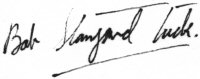 Wing Commander Bob Stanford Tuck DSO DFC** (deceased) *Signature Value : £75 (clipped) | Bob Stanford Tuck was a flamboyant fighter pilot, his dashing good looks, courage, and success in the air coming to epitomise the young flyers who fought and won the Battle of Britain. To the British public he was a hero in the mould of the knights of old, and today his name is legend. In the early stages of the Battle of Britain Bob fought with 92 Squadron flying Spitfires, quickly becoming one of the leading aces. Promoted to command 257 Squadron, now flying Hurricanes, Bobs dashing style of leadership inspired his pilots to great success. He went on to command the Duxford and Biggin Hill Wings, taking his personal score to 29 air victories before being shot down by ground fire over Northern France in 1942. He died on 5th May 1987. |
| The Aircraft : | |
| Name | Info |
| Hurricane | Royal Air Force Fighter, the Hawker Hurricane had a top speed of 320mph, at 18,200 feet and 340mph at 17,500, ceiling of 34,200 and a range of 935 miles. The Hurricane was armed with eight fixed wing mounted .303 browning machine guns in the Mark I and twelve .303 browning's in the MKIIB in the Hurricane MKIIC it had four 20mm cannon. All time classic fighter the Hurricane was designed in 1933-1934, the first prototype flew in June 1936 and a contract for 600 for the Royal Air Force was placed. The first production model flew ion the 12th October 1937 and 111 squadron of the Royal Air Force received the first Hurricanes in January 1938. By the outbreak of World war two the Royal Air Force had 18 operational squadrons of Hurricanes. During the Battle of Britain a total of 1715 Hurricanes took part, (which was more than the rest of the aircraft of the Royal air force put together) and almost 75% of the Victories during the Battle of Britain went to hurricane pilots. The Hawker Hurricane was used in all theatres during World war two, and in many roles. in total 14,533 Hurricanes were built. |
| He111 | The German medium bomber the Heinkel He111 was designed by Siegfried and Walter Günter. The first He111 flew on 24th of February 1935, piloted by chief test pilot Gerhard Nitschke. The Heinkel He111 was the primary medium bomber of the Luftwaffe during the opening years of World War Two and the major bomber during the Battle of Britain. It was also used as a torpedo bomber during the Battle of the Atlantic. The Heinkel He111 was used in all theatres, Western, Eastern, Middle East and Northern Africa. He111 continued in production into 1944 and by the end of the war it was used primarily as a transport. Its origins came from a pre war airliner design. |
|
Contact Details |
|
Sign Up To Our Newsletter!
This website is owned by Cranston Fine Arts. Torwood House, Torwoodhill Road, Rhu, Helensburgh, Scotland, G848LE Contact: Tel: (+44) (0) 1436 820269. Email: cranstonorders -at- outlook.com
|
 |




 Buy 1 Get 1 Half Price!
 (clipped)


